KG To Grade 8
A Strong Start. A Brighter Future.
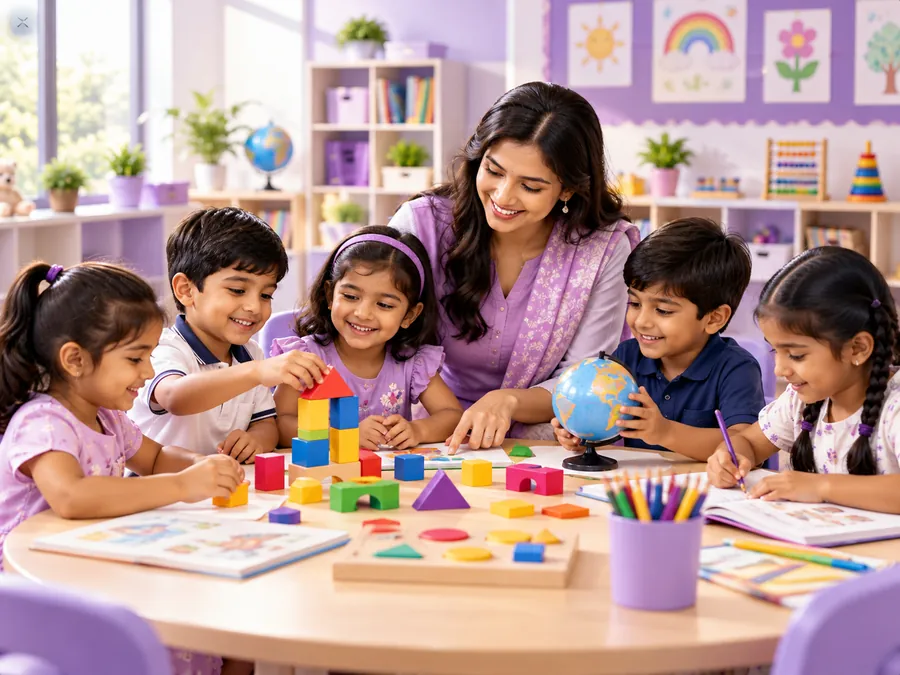
At GLH Education, our student-centered learning approach guides children from foundational discovery in Kindergarten through Grade 8 academic preparation. We combine strong conceptual foundations, digital literacy, interactive learning and holistic character building at every stage.
- Early Foundations
- Concept-Based Learning
- Digital Skills
KG to Grade 8
Learning that grows with every child
Discover Our Four Learning Stages
01 / LEARNING STAGE
KG1–KG2
Early Childhood
A structured focus on phonics, early numeracy, environmental awareness, and cognitive development to prepare students for primary education.
See curriculum →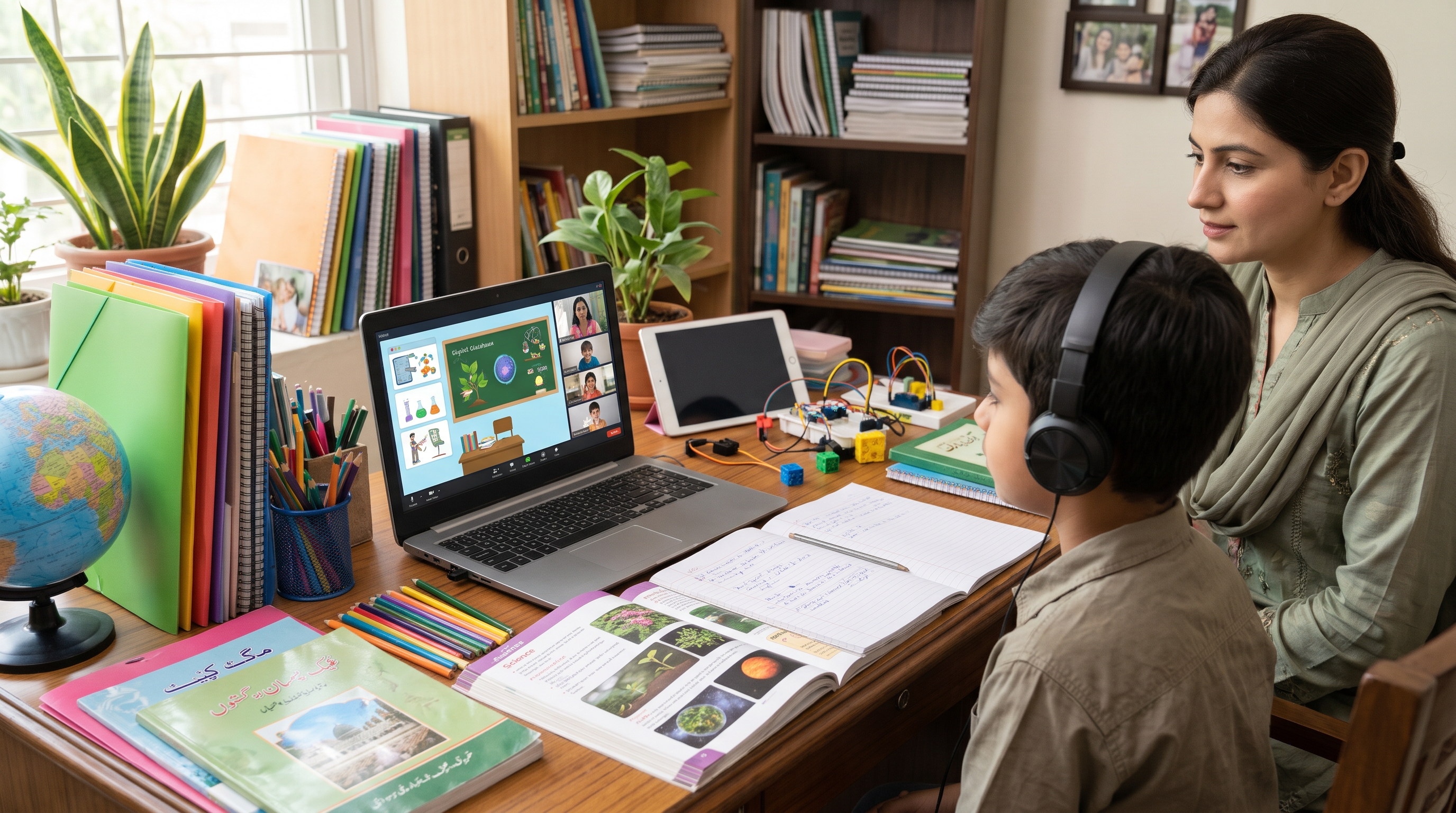
02 / LEARNING STAGE
Grades 1–5
Primary Education
Focused on developing strong skills in English, Mathematics, Science, AI and Social Studies, alongside essential regional subjects like Urdu and Islamic Studies.
See curriculum →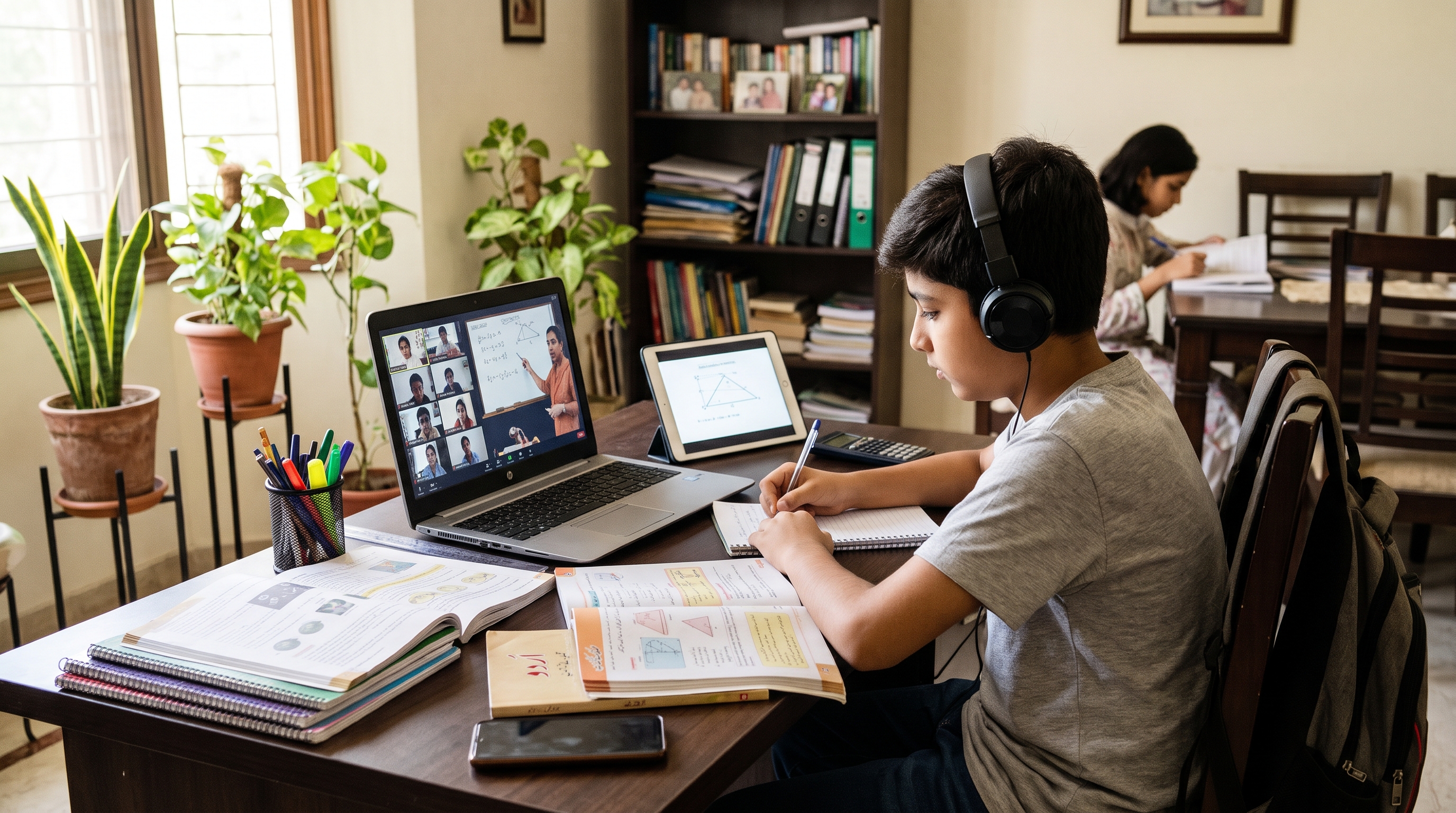
03 / LEARNING STAGE
Grades 6–8
Middle School
The curriculum expands to include specialized instruction in higher-level Mathematics, detailed Sciences, AI and digital literacy, alongside comprehensive English, Urdu, and Islamic Studies.
See curriculum →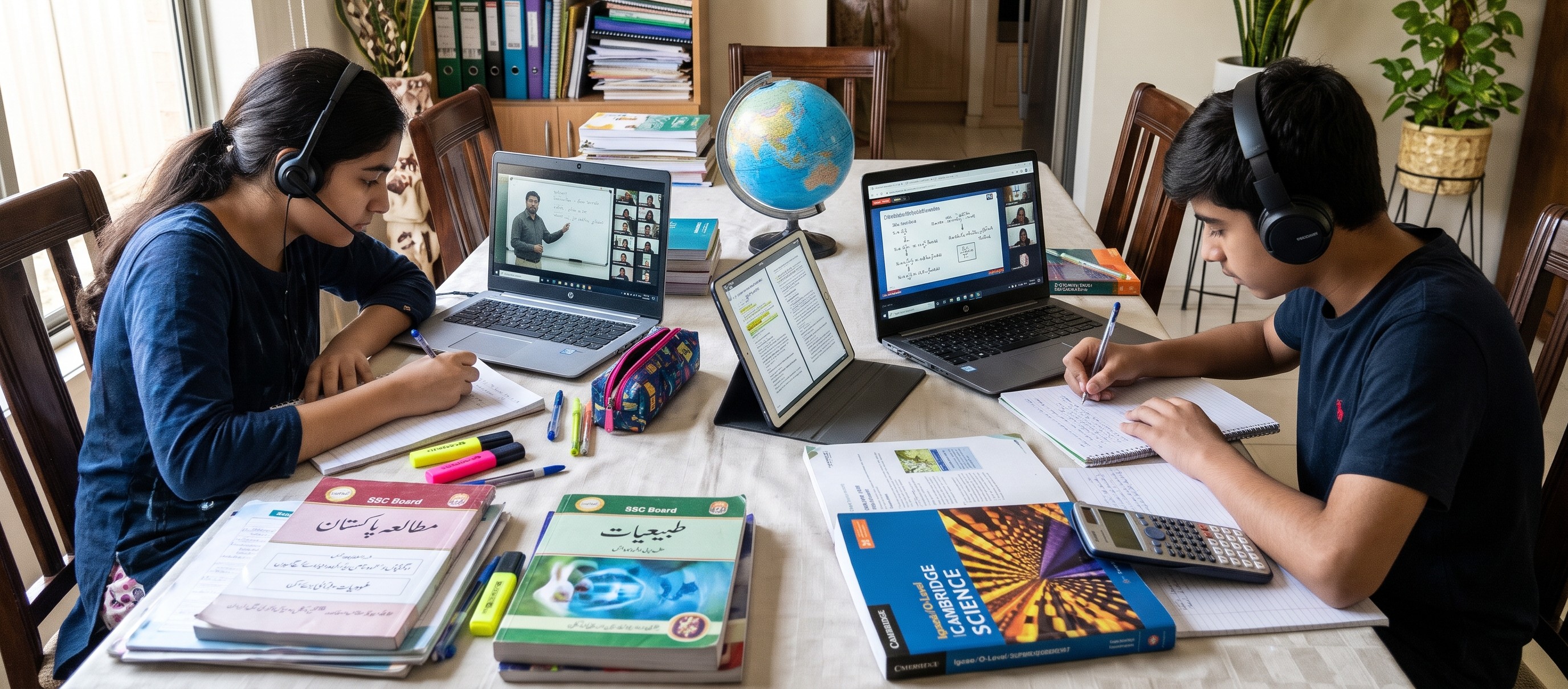
04 / LEARNING STAGE
O-LVL / SSC I & II
Upper Secondary Preparation
At Global Learning Hub (GLH), our Secondary School program prepares students for board exams with two pathways : Cambridge O-Levels and the Pakistan National Curriculum (SSC I & II / Matric), both delivered online.
See curriculum →

Connected Learning. Anytime, Anywhere.
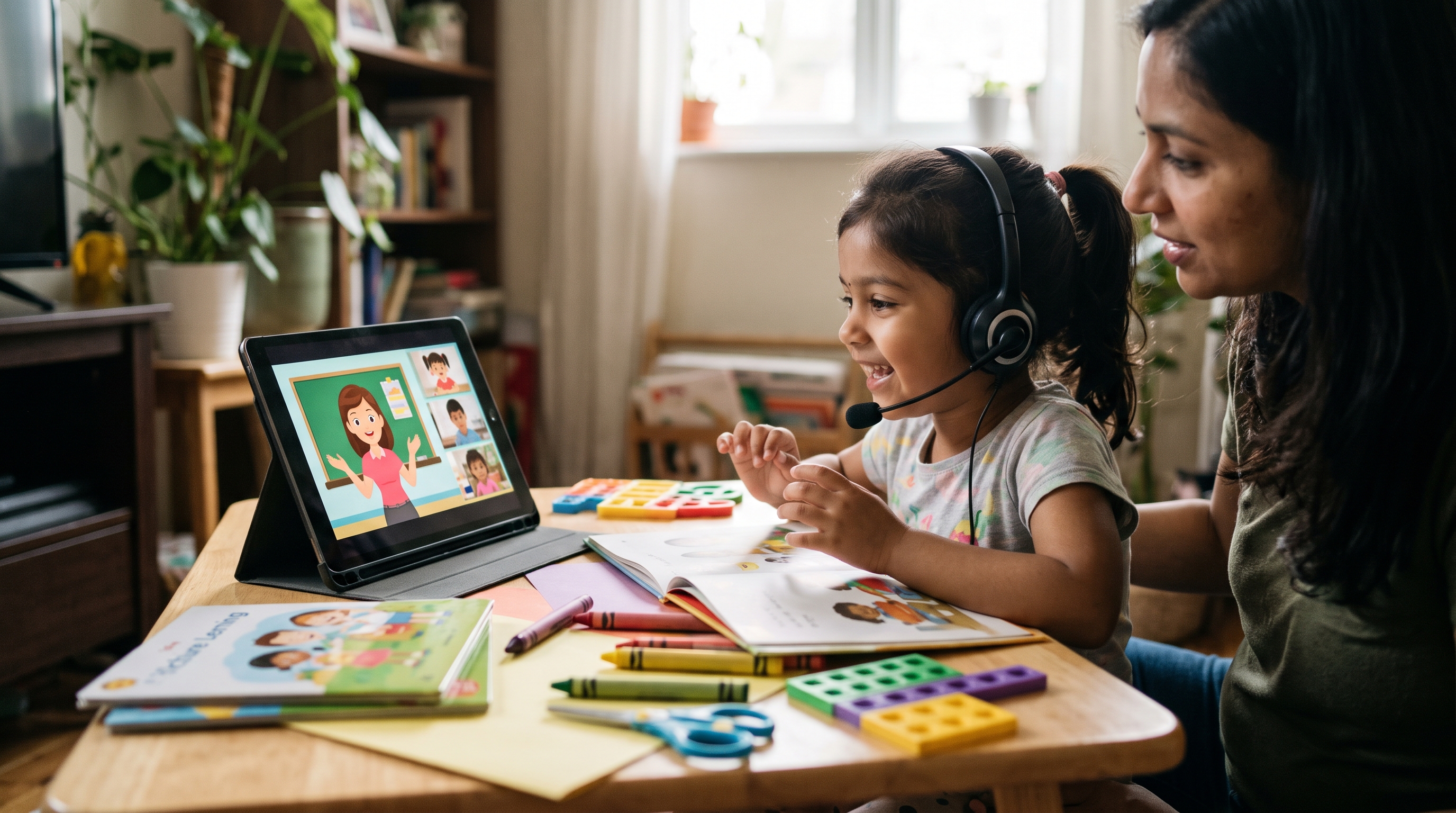
GLH combines interactive online learning with academic support. The curriculum describes live lectures, accessible recordings, online quizzes, digital tools and opportunities for students and parents to follow academic progress.
Live Interactive Classes
Join live lessons and participate in guided learning experiences.
Recorded Lectures
Return to recorded lessons when revision or reinforcement is needed.
Digital Assessments
Practice with online quizzes, regular assessments and exam preparation tools.
Progress Tracking
Follow academic progress through online reporting and parent-teacher feedback.
Explore the Curriculum & Textbooks
Click on a grade to view the textbook and subject resources listed in GLH's curricula document.
KG1–KG2 Early Childhood
KG-1Primary curriculum & textbooks
KG-1 Books & Curriculum (2026–2027)
1. KG-1 Booklist
Subject Book / Resource Title Author / Publisher Notes / ISBN Mathematics Cambridge Primary Mathematics (Learner's Book 1) Cherri Moseley & Janet Rees (Cambridge) ISBN: 978-1-107-63131-1 English (Alphabet & Phonics) Alphabet Activities Meryeme Afroukh Letter matching, tracing & alphabet activities English (Reading) Alphabet Sentences (v1.0) Sidra Ayyaz A–Z early sentence reading English (Minibooks) Alphabet Minibooks (v1.0) Kulsoom Ayyaz Letter recognition, coloring & vocabulary Urdu Urdu KG-1 Oxford University Press Huruf-e-Tahajji, vowels & basic writing 2. Subject-Wise Curriculum Overview
- Mathematics: Early number recognition, counting, number pairs, basic shapes, and problem-solving through visual activities.
- English: Uppercase and lowercase letter recognition, letter-sound phonics, tracing, coloring, and simple A–Z sentence reading.
- Urdu: Recognition and formation of Huruf-e-Tahajji, short and long vowels (Musawitay), and foundational reading skills.
KG-2Primary curriculum & textbooks
KG-2 Books & Curriculum (2026–2027)
1. KG-2 Booklist
Subject Book / Resource Title Author / Publisher Notes / ISBN Mathematics Cambridge Primary Mathematics (Workbook 1) Cherri Moseley & Janet Rees (Cambridge) Numbers, counting, shapes & measurement practice English (Coursebook) Cambridge Primary English (Learner's Book 1) Gill Budgell & Kate Ruttle (Cambridge) Story comprehension, speaking & early writing English (Phonics) Jolly Phonics Activity Book 2 Sara Wernham & Sue Lloyd (Jolly Learning) Phonics sounds, letter formation & word blending English (Vocabulary) Cambridge English: Pre A1 Starters Word List Picture Book Cambridge University Press Thematic picture scenes & A–Z Pre A1 vocabulary World Around Us & GK First Steps to Early Years: World Around Us (Primer 2) Farhana Akbar (Oxford University Press) ISBN: 9780190707828 Urdu Urdu ka Guldasta: Taaray (KG Reader) Fauzia Ihsan Farooqi (Oxford University Press) Phonetic & sight words, poems & short stories 2. Subject-Wise Curriculum Overview
- Mathematics: Counting, number recognition, simple addition and subtraction foundations, 2D shapes, colors, and introductory measurement activities.
- English & Phonics: Multi-sensory phonics blending (Jolly Phonics), letter formation, story retelling and comprehension (Cambridge Primary English), and thematic everyday vocabulary (Pre A1 Starters).
- World Around Us & General Knowledge: Animals, fruits and vegetables, family, body parts, senses, home and school environments, nature, health and hygiene, and IQ-booster activities.
- Urdu: Phonetic and sight-word reading (Taaray), 3- and 4-letter word formation, basic sentence comprehension, rhymes (Hamd and Naat), and moral stories.
Primary
Grade 1Primary curriculum & textbooks
Grade 1 Books & Curriculum (2026–2027)
1. Grade 1 Booklist
Subject Book / Resource Title Author / Publisher ISBN / Code Mathematics Cambridge Primary Mathematics (Learner's Book 1 & Workbook 1) Cheri Moseley & Janet Rees (Cambridge) 9781108746410 Science Cambridge Primary Science (Learner's Book 1 & Workbook 1) Jon Board & Alan Cross (Cambridge) 9781108742726 English Cambridge Primary English (Learner's Book 1 & Workbook 1) Gill Budgell (Cambridge) 9781009111409 History Oxford International Primary History 1 Oxford University Press — Geography Oxford International Primary Geography 1 Oxford University Press — Islamic Studies Oxford Islamic Studies Grade 1 Maulvi Abdul Aziz (Oxford) — Urdu Motia & Nardban-e-Urdu (Grade 1) Fauzia Ihsan Farooqi (Oxford) — English Literature A Job for Jojo Shandra Owens (Houghton Mifflin) — AI / Computer Skillful Minds (Book 1) STEMpedia — Arts AFAQ Sun Series Visual Arts 1 AFAQ — 2. Subject-Wise Curriculum Overview
Mathematics (Learner's Book & Workbook 1)
- Numbers: Counting 0–20 (forward to 100); skip counting by 2s, 5s, and 10s; basic place value (tens and ones); fractions (halving shapes and amounts).
- Calculation: Number pairs to 10; basic doubles and near-doubles; addition (combining) and subtraction (taking away) word problems.
- Geometry & Measure: Naming and sorting common 2D shapes and 3D solids; positional language; days of the week; telling time to the hour.
- Data & Thinking: Grouping objects and sorting data into simple lists or tables; testing examples, finding patterns, and explaining mathematical reasoning.
Science (Learner's Book & Workbook 1)
- Living Things (Biology): Identifying human body parts, senses, and basic animal structures; naming major plant parts (roots, leaves, flowers) and exploring plant growth.
- Materials & Environment (Chemistry & Earth): Sorting objects by properties (hard, smooth, wood, plastic); observing daily weather changes, seasons, and the night sky.
- Physical World (Physics): Exploring how objects move using simple pushes and pulls; identifying different sounds and how they are made.
- Scientific Inquiry: Asking questions, making predictions, testing ideas, and tracking results.
English (Learner's Book & Workbook 1)
- Reading & Phonics: Letter-sound correspondences, blending sounds, and decoding short words; retelling stories, identifying main characters, and sequencing events.
- Writing & Grammar: Letter formation, spacing, capital letters, and ending punctuation (periods); using basic nouns, verbs, adjectives, and simple sentence structures.
- Speaking & Listening: Following simple multi-step instructions, listening to read-alouds, expressing ideas clearly, asking questions, and participating in conversations.
- Vocabulary & Spelling: Recognizing high-frequency sight words and learning new thematic vocabulary.
English Literature (A Job for Jojo)
- Literacy & Reading Development: Story structure comprehension, guiding children to identify key narrative elements.
- Social-Emotional Learning (SEL): Empathy and compassion through therapy and companion animals; community engagement through small acts of kindness; cooperation and responsibility through shared tasks like washing and preparing Jojo.
International Primary History 1
- Core Concepts & Skills: Understanding history, measuring time using timelines and centuries, and analyzing sources (photos and journals) to compare past and present life.
- Personal & Social History: Personal growth, family structures, family trees, and generational changes.
- History of Daily Life: Evolution of home routines, lighting, cooking, water supply, and hygiene.
- World Exploration: Global geography and historical explorers including Ibn Battuta, Christopher Columbus, and Edmund Hillary.
International Primary Geography 1
- My School: Classroom shapes, left and right directions, bird's-eye view plans, and mapping school grounds.
- The Local Area: Towns and cities, house styles, community helper jobs, and street signs.
- Going Places: Modes of travel, trips abroad, holiday weather, and landforms such as deserts, forests, and mountains.
Islamic Studies (Grade 1)
- Core Areas: Quranic Studies, Aqeedah (Belief), Seerah (Life of Prophet Muhammad), Ibadah (Worship), Akhlaq (Morals and Ethics), Islamic History, Islamic Values and Character Building, and Application of Knowledge.
Urdu (Motia & Nardban-e-Urdu)
- Core Skills: Reading and Comprehension (فہم اور مطالعہ), Writing Skills (لکھنے کی مہارت), Vocabulary and Spelling (ذخیرہ الفاظ اور املا), Poetry (نظم), Speaking and Listening (سننے اور بولنے کی مہارت), Culture and Values (اقدار اور ثقافت), Famous Personalities (مشہور شخصیات), and Grammar (قواعد).
AI / Computer (Skillful Minds — Book 1)
- Computer Basics: Hardware parts, keyboard and mouse skills, lab rules, and digital drawing using MS Paint.
- Coding & Robotics: Pattern recognition, sequencing, algorithmic thinking, visual coding blocks in PictoBlox Jr., and hands-on activities with the Quarky robot kit.
- Artificial Intelligence (AI): Introduction to machine intelligence, hands-on face detection vision projects, and project submissions with digital certificates.
Arts (AFAQ Sun Series Visual Arts 1)
- Core Areas: Drawing and Sketching, Painting, Craftwork, Sculpture and 3D Art, Textile and Fabric Art, Art Appreciation, and Integrated Art.
Grade 2Primary curriculum & textbooks
Grade 2 Books & Curriculum (2026–2027)
1. Grade 2 Booklist
Subject Book / Resource Title Author / Publisher Mathematics Cambridge Primary Mathematics (Learner's Book 2 & Workbook 2) Cheri Moseley & Janet Rees (Cambridge) Science Cambridge Primary Science (Learner's Book 2 & Workbook 2) Jon Board & Alan Cross (Cambridge) English Cambridge Primary English (Learner's Book 2 & Workbook 2) Gill Budgell & Kate Ruttle (Cambridge) Geography Oxford International Primary Geography 2 Oxford University Press History Oxford International Primary History 2 Oxford University Press Islamic Studies Islamic Studies Grade 2 Molvi Abdul Aziz (Darussalam) Urdu Gainda & Nardban-e-Urdu (Grade 2) Fauzia Ihsan Farooqi (Oxford) AI / Computer Skillful Minds (Book 2) STEMpedia Arts AFAQ Sun Series Visual Arts 2 AFAQ 2. Subject-Wise Curriculum Overview
Mathematics (Learner's Book & Workbook 2)
- Numbers & Reasoning: Thinking and working mathematically; numbers to 100.
- Applied Projects: Project 1 (Possibly odd) and Project 2 (Strange submarines).
- Geometry & Measurement: Shapes and geometry, measures, money, and telling time.
- Data Handling: Collecting, sorting, and interpreting basic data sets.
Science (Learner's Book & Workbook 2)
- Living Things & Environment: Classification of living things, microorganisms, flowers and seeds, and environmental pollution.
- Matter & Physical World: Physical and chemical changes of matter, light and sound, and electricity and magnetism.
- Earth, Space & Technology: Structure of the Earth, space and satellites, and technology in everyday life.
English (Learner's Book & Workbook 2)
- Reading & Literature: Reading comprehension, poetry appreciation, and literature (prose and stories).
- Writing & Language: Grammar and language structure, vocabulary building, and guided writing skills.
- Communication: Speaking and listening skills through interactive classroom discussions.
International Primary Geography 2
- The Wider World: Introduces the Earth as a sphere, its 7 continents, 5 oceans, over 190 countries, and basic environment and recycling concepts.
- An Island Home: Explores island geography, island transport, and a detailed case study on the island country of Bahrain.
- Going to the Seaside: Covers coastal features, tides, coastal settlements, popular holiday resorts (Malta, Florida, Jamaica), and seafood harvesting.
- How We Learn About the World: Explains how our 5 senses, vision tools (magnifying glasses, telescopes), and satellites help us study the Earth.
- Passport to the World: Looks at global climate zones, international trade, and a geographic spotlight on China and Shanghai.
International Primary History 2
- Toys and Games Over Time: Comparing grandparents' toys to modern toys; how materials changed from wood, cloth, and clay to plastic and electronics; collecting oral history interviews and building timelines.
- Three English Queens: Studying Queen Elizabeth I, Queen Victoria, and Queen Elizabeth II; reading clues and symbols in historical portraits; exploring how everyday life and technology changed across centuries.
- Air and Space Travel: Tracing human flight from hot-air balloons and early planes to modern jets; major space achievements including satellites and reaching the Moon; understanding how faster travel connected the world.
Islamic Studies (Grade 2)
- Core Areas: Quranic Studies, Aqeedah (Belief), Seerah (Life of Prophet Muhammad), Ibadah (Worship), Akhlaq (Morals and Ethics), Islamic History, Islamic Values and Character Building, and Application of Knowledge.
Urdu (Gainda & Nardban-e-Urdu)
- Core Skills: Reading and Comprehension (فہم اور مطالعہ), Writing Skills (لکھنے کی مہارت), Vocabulary and Spelling (املا اور لغت), Poetry (نظم), Speaking and Listening (سننے اور بولنے کی مہارت), Culture and Values (اقدار اور ثقافت), Famous Personalities (مشہور شخصیات), and Grammar (قواعد).
AI / Computer (Skillful Minds — Book 2)
- AI Foundations: Introduction to AI, AI in everyday life, fundamentals of machine learning, and AI and ethics.
- Practical Coding & Future Tech: Fun with AI tools, programming basics for AI, AI in the future, and hands-on projects and activities.
Arts (AFAQ Sun Series Visual Arts 2)
- Core Areas: Drawing and Sketching, Painting, Craftwork, Sculpture and 3D Art, Textile and Fabric Art, Art Appreciation, and Integrated Art.
Grade 3Primary curriculum & textbooks
Grade 3 Books & Curriculum (2026–2027)
1. Grade 3 Booklist
Subject Book / Resource Title Author / Publisher Mathematics Cambridge Primary Mathematics (Learner's Book 3 & Workbook 3) Cheri Moseley & Janet Rees (Cambridge) Science Cambridge Primary Science (Learner's Book 3 & Workbook 3) Jon Board & Alan Cross (Cambridge) English Cambridge Primary English (Learner's Book 3 & Workbook 3) Sarah Lindsay & Kate Ruttle (Cambridge) Geography Oxford International Primary Geography 3 Oxford University Press History Oxford International Primary History 3 Oxford University Press Islamic Studies Islamic Studies Grade 3 Maulvi Abdul Aziz (Darussalam) Urdu Sada Bahar & Nardban-e-Urdu (Grade 3) Fauzia Ihsan Farooqi (Oxford) AI / Computer Skillful Minds (Book 3) STEMpedia Arts AFAQ Sun Series Visual Arts 3 AFAQ 2. Subject-Wise Curriculum Overview
Mathematics (Learner's Book & Workbook 3)
- Number & Operations: Place value, addition and subtraction, multiplication and division, and fractions and decimals.
- Algebra & Patterns: Identifying patterns, number sentences, expressions and equations, and variables.
- Geometry & Spatial Sense: 2D shapes and 3D solids, lines and angles, symmetry, and spatial transformations.
- Measurement: Length, mass and capacity, perimeter and area, time and calendar, and money and currency.
- Data Handling & Probability: Tally marks and charts, bar graphs and pictographs, data interpretation, and likelihood and chance.
- Problem Solving & Logic: Word problems, critical thinking strategies, step-by-step reasoning, and real-world math applications.
- Mental Math & Fluency: Quick recall exercises, estimation strategies, math drills, and speed challenges.
- Mathematical Tools: Using rulers, protractors, grids, calculators, and geometric manipulatives.
Science (Learner's Book & Workbook 3)
- Scientific Inquiry: Asking questions, planning investigations, data collection, and analyzing evidence.
- Life Sciences: Plants and animals, human body and health, ecosystems and habitats, and life cycles.
- Physical Sciences: Properties of matter, forces and motion, light and sound, and electricity and magnetism.
- Earth & Space: Weather and seasons, rocks, soil and water, Earth's resources, and the solar system and stars.
- Science & Environment: Pollution, conservation and recycling, climate change, and biodiversity.
- Hands-On Labs & Experiments: Step-by-step practical activities, safety guidelines, and scientific observations.
- Cross-Curricular STEM: Engineering design challenges, technology integration, and math-in-science applications.
English (Learner's Book & Workbook 3)
- Reading: Word recognition and phonics, comprehension, vocabulary, and fluency and expression.
- Writing: Handwriting, creative writing, presentation, and grammar, spelling, and punctuation.
- Speaking & Listening: Speaking, listening, and drama and role play.
- Vocabulary Development: Word boxes, language focus, and contextual learning.
- Literature Exploration: International fiction, non-fiction, poetry, myths, and legends.
- Phonics & Spelling: Systematic spelling patterns, phonemes, and regular progress checks.
International Primary Geography 3
- Core Focus: Foundational geography skills exploring how geography shapes daily life, settlement patterns, and the environment across global communities.
- Map Skills & Navigation: Map reading, understanding map scales and symbols, and using a compass to find directions.
- Settlements & Agriculture: Village life, land use, and farming methods—highlighting real-world examples such as the village of Dana in Jordan and global agricultural practices.
- Weather & Climate: Global climate patterns, hot and cold regions, factors influencing weather, and case studies including life in Switzerland and Cairo.
- Environment & Modern Life: How human activity interacts with the environment, seasonal changes, daily transportation, news, and global communication.
International Primary History 3
- From Hunter-Gatherers to Village People: Tracing human life from nomadic Stone Age hunting, gathering, cave art, and fire use to the birth of farming, early technology, and permanent settlements like Skara Brae.
- The Metal Ages: The technological leap from stone tools to bronze and iron, highlighting advances in farming, trade networks, roundhouse settlements, hill forts, and tribal societies.
- Early Civilisations: Development of ancient river valley societies focusing on irrigation, organized city life, social hierarchies, early writing systems, trade networks, and warfare.
- A History of Communication: How humans shared information over time, from early writing tools and the printing press to postal networks, telecommunications, and modern mass media.
Islamic Studies (Grade 3)
- Core Areas: Beliefs (Aqeedah), Quranic Studies, Seerah (Life of Prophet Muhammad), Ibadah (Worship), Islamic Values and Manners (Akhlaq), Islamic History, Islamic Calendar and Events, and Islamic Etiquettes (Adab).
Urdu (Sada Bahar & Nardban-e-Urdu)
- Core Skills: Reading and Comprehension (فہم اور مطالعہ), Writing Skills (مہارت تحریری), Vocabulary and Spelling (املا اور لغت), Literature Appreciation (مطالعہ کا ادب), Speaking and Listening (سننے اور بولنے کی مہارت), Moral and Ethical Values (اخلاقیات), and Grammar (قواعد).
AI / Computer (Skillful Minds — Book 3)
- AI Foundations: Introduction to AI, AI in everyday life, fundamentals of machine learning, and AI and ethics.
- Practical Coding & Future Tech: Fun with AI tools, programming basics for AI, AI in the future, and hands-on projects and activities.
Arts (AFAQ Sun Series Visual Arts 3)
- Core Areas: Drawing and Sketching, Painting, Craftwork, Sculpture and 3D Art, Textile and Fabric Art, Art Appreciation, and Integrated Art.
Grade 4Primary curriculum & textbooks
Grade 4 Books & Curriculum (2026–2027)
1. Grade 4 Booklist
Subject Book / Resource Title Author / Publisher Mathematics Cambridge Primary Mathematics (Learner's Book 4 & Workbook 4) Emma Low & Mary Wood (Cambridge) Science Cambridge Primary Science (Learner's Book 4 & Workbook 4) Fiona Baxter & Liz Dilley (Cambridge) English Cambridge Primary English (Learner's Book 4 & Workbook 4) Sally Burt & Debbie Ridgard (Cambridge) History Oxford International Primary History 4 Oxford University Press Geography Oxford International Primary Geography 4 Oxford University Press Islamic Studies Islamic Studies Grade 4 Maulvi Abdul Aziz (Darussalam) Urdu Nargis & Nardban-e-Urdu (Grade 4) Fauzia Ihsan Farooqi (Oxford) Quran Holy Quran (Nazra, Tajweed & Quranic Stories) GLH Quran Studies Curriculum AI / Computer Skillful Minds (Book 4) STEMpedia Arts AFAQ Sun Series Visual Arts 4 AFAQ 2. Subject-Wise Curriculum Overview
Mathematics (Learner's Book & Workbook 4)
- Core Strands: Numbers and Operations, Geometry, Measurement, Data Handling, Algebra and Patterns, and Problem-Solving.
Science (Learner's Book & Workbook 4)
- Core Strands: Biology (Living Things and Their Habitats), Chemistry (Materials and Their Properties), Physics (Forces, Energy, and Light), Earth and Space, and Scientific Skills.
English (Learner's Book & Workbook 4)
- Reading: Fiction and non-fiction texts, comprehension skills, vocabulary building, and literary devices (such as metaphors and similes).
- Writing: Narrative and descriptive writing, poetry and playwriting, and handwriting and presentation.
- Speaking & Listening: Debates and discussions, presentations and role-plays, and listening comprehension and response.
- Literature & Creative Expression: Exploring different genres, analyzing literature, and creative writing.
- Integrated Competencies: Key skills integration, developing research skills, and cross-curricular links.
International Primary History 4
- Ancient Egypt: Egypt and the pharaohs, farming and trade, everyday life in Ancient Egypt, tombs and treasures, and the Egyptian influence (evidence and inspiration).
- Ancient Greece: Who the Ancient Greeks were, work and relaxation, everyday life in Ancient Greece, soldiers and seafarers, and trade, art, and ideas.
- Ancient Rome: The beginnings of Ancient Rome, the start of the Roman Empire, ancient Roman towns and cities, everyday life in the empire, and Roman art and culture.
- A History of Leisure and Recreation: Games, sport, the history of holidays, storytelling as entertainment, and educational recreation.
International Primary Geography 4
- Improving the Environment: Our environment, rubbish and litter, recycling rubbish, oil and energy impacts on the environment, noise pollution, and environmental improvement.
- Village Settlers: Early villages, Balad Sayt Village case study, and how a village grows.
- Leisure Time: Leisure activities and how leisure shapes land use.
- What's in the News? (Earthquakes & Volcanoes): Understanding natural hazards including earthquakes and volcanoes.
- Regional Studies: Geography of Pakistan and History of Pakistan.
Islamic Studies (Grade 4)
- Core Areas: Quranic Studies, Aqeedah (Belief), Seerah (Life of Prophet Muhammad), Ibadah (Worship), Akhlaq (Morals and Ethics), Islamic History, Islamic Values and Character Building, and Application of Knowledge.
Urdu (Nargis & Nardban-e-Urdu)
- Core Skills: Reading and Comprehension (فہم اور مطالعہ), Writing Skills (مہارت تحریری), Vocabulary and Spelling (املا اور لغت), Poetry (نظم), Speaking and Listening (سننے اور بولنے کی مہارت), Culture and Values (اقدار اور ثقافت), Famous Personalities (مشہور شخصیات), and Grammar (قواعد).
Quran Studies (Grade 4)
- Core Areas: Recitation (Tilawat), Tajweed (تجوید), and Stories from the Quran.
AI / Computer (Skillful Minds — Book 4)
- AI Foundations: Introduction to AI, AI in everyday life, fundamentals of machine learning, and AI and ethics.
- Practical Coding & Future Tech: Fun with AI tools, programming basics for AI, AI in the future, and hands-on projects and activities.
Arts (AFAQ Sun Series Visual Arts 4)
- Core Areas: Drawing and Sketching, Painting, Craftwork, Sculpture and 3D Art, Textile and Fabric Art, Art Appreciation, and Integrated Art.
Grade 5Primary curriculum & textbooks
Grade 5 Books & Curriculum (2026–2027)
1. Grade 5 Booklist
Subject Book / Resource Title Author / Publisher Mathematics Cambridge Primary Mathematics (Digital Learner's Book 5 & Workbook 5) Emma Low & Mary Wood (Cambridge) Science Cambridge Primary Science (Learner's Book 5 & Workbook 5) Fiona Baxter & Liz Dilley (Cambridge) English Cambridge Primary English (Learner's Book 5 & Workbook 5) Sally Burt & Debbie Ridgard (Cambridge) English Literature Charlie and the Chocolate Factory Roald Dahl (Puffin Modern Classics) Geography Oxford International Primary Geography 5 Oxford University Press History Oxford International Primary History 5 Oxford University Press Islamic Studies Islamic Studies Grade 5 Molvi Abdul Aziz (Darussalam) Urdu Gul-e-Lala & Nardban-e-Urdu (Grade 5) Fauzia Ihsan Farooqi (Oxford) AI / Computer Skillful Minds (Book 5) STEMpedia Arts Visual Arts — Art for All (Grade 5) GLH Arts Curriculum 2. Subject-Wise Curriculum Overview
Mathematics (Digital Learner's Book & Workbook 5)
- Numbers & Operations: Whole numbers, operations on numbers, multiples and factors, fractions, decimals, percentage, ratio and proportion, and unitary methods.
- Geometry & Measurement: Geometry, perimeter and area, and distance and time.
- Data Handling: Collecting, organizing, and interpreting data sets.
Science (Learner's Book & Workbook 5)
- Living Things & Environment: Classification of living things, microorganisms, flowers and seeds, and environmental pollution.
- Matter & Physical World: Physical and chemical changes of matter, light and sound, and electricity and magnetism.
- Earth, Space & Technology: Structure of the Earth, space and satellites, and technology in everyday life.
English (Learner's Book & Workbook 5)
- Reading & Literature: Reading comprehension, poetry appreciation, and literature (prose and stories).
- Writing & Language: Grammar and language structure, vocabulary building, and writing skills.
- Communication: Speaking and listening skills through structured discussions and presentations.
English Literature (Charlie and the Chocolate Factory)
- Critiquing Bad Behavior: Highlights and satirizes negative traits in children and parenting—such as greed (Augustus Gloop), entitlement (Veruca Salt), excessive habit and disrespect (Violet Beauregarde), and screen obsession and aggression (Mike Teavee).
- Rewarding Virtue: Showcases how humility, kindness, and self-restraint (embodied by Charlie Bucket) triumph over vice and selfishness.
- Imaginative Storytelling: Sparks creativity and reader engagement through Willy Wonka's eccentric genius and fantastical inventions, including chocolate rivers, everlasting gobstoppers, and hair toffee.
International Primary Geography 5
- Water: Explores the importance of water, global distribution, supply and cleaning processes, life in extreme environments (deserts and rainforests), drought, and water ownership.
- Transport: Examines forms of transportation, growing road traffic, related environmental and social challenges, and modern traffic management solutions.
- Coasts: Covers natural coastal features, ocean movements, how waves shape landscapes, and beach formation.
- Coastal Settlements: Discusses coastal communities and major global port and trade cities, including Aqaba, Jebel Ali, Singapore, and Rotterdam.
- Wind: Focuses on wind power, measuring wind direction and strength, and severe weather phenomena such as hurricanes and tornadoes.
International Primary History 5
- Roman Invasion: Covers the expansion and organization of the Roman army and empire, the Roman invasion of Britain, Celtic resistance, Roman towns and villas, daily army life, and factors leading to the decline of the Roman Empire.
- The Anglo-Saxons: Introduces the origin, rulers, and social structure of the Anglo-Saxons, village life, cultural achievements, and subsequent Viking invasions.
- The Maya: Examines Mayan civilization, city structures, rulers, merchant trade systems, and major cultural, scientific, and architectural achievements.
- A History of Transport: Traces the evolution of transportation across road, water, rail, and air travel, along with concepts for future transport.
Islamic Studies (Grade 5)
- Core Areas: Quranic Studies, Aqeedah (Belief), Seerah (Life of Prophet Muhammad), Ibadah (Worship), Akhlaq (Morals and Ethics), Islamic History, Islamic Values and Character Building, and Application of Knowledge.
Urdu (Gul-e-Lala & Nardban-e-Urdu)
- Core Skills: Reading and Comprehension (مطالعہ اور فہم), Writing Skills (مہارت تحریری), Vocabulary and Spelling (لغت اور املا), Poetry (نظم), Speaking and Listening (بولنے اور سننے کی مہارت), Culture and Values (ثقافت اور اقدار), Famous Personalities (مشہور شخصیات), and Grammar (قواعد).
AI / Computer (Skillful Minds — Book 5)
- Computer Fundamentals & Office Productivity: Know Your Computer (OS, history, and CPU hardware basics), Windows 10 and digital tools (file navigation, Snipping Tool, WordPad), MS Word (tables, page layouts, formatting), and PowerPoint (multimedia slides, transitions, themes).
- Coding & Game Design: Coding and algorithmic thinking (problem-solving, decomposition, flowchart symbols), block coding in PictoBlox (coordinate stages, sprites, block palettes), and Game & Animation Lab (sprite walk animations and interactive games).
- Robotics & Artificial Intelligence: Fun with Robotics (hardware mechanics and physical computing), programming the Quarky robot (LED matrices, buzzers, wireless motion controls), The World of AI (machine learning and human-computer interaction), and Computer Vision & Speech AI (face tracking, finger tracing, voice recognition).
Arts (Visual Arts — Art for All)
- Core Areas: Drawing and Sketching, Painting, Craftwork, Sculpture and 3D Art, Textile and Fabric Art, Art Appreciation, and Integrated Art.
Middle School
Grade 6Middle School curriculum & textbooks
Grade 6 Books & Curriculum (2026–2027)
1. Grade 6 Booklist
Subject Book / Resource Title Author / Publisher Mathematics Cambridge Primary Mathematics (Learner's Book 6) Mary Wood, Emma Low, Greg Byrd & Lynn Byrd (Cambridge) Science Cambridge Primary Science (Learner's Book 6) Fiona Baxter & Liz Dilley (Cambridge) English Cambridge Primary English (Learner's Book 6) Sally Burt & Debbie Ridgard (Cambridge) Computer Oxford International Primary Computing (Student Book 6) Alison Page, Howard Lincoln & Karl Held (Oxford) History Oxford International Primary History 6 Oxford University Press Islamic Studies Islamic Studies Grade 6 GLH Islamic Studies Curriculum Urdu Nardban-e-Urdu (Grade 6) Fauzia Ihsan Farooqi (Oxford) Artificial Intelligence (AI) Artificial Intelligence (Grade 6) Create & Learn 2. Subject-Wise Curriculum Overview
Mathematics (Learner's Book 6)
- Number: Number system, sequences, and laws of arithmetic.
- Geometry & Measure: 2D and 3D shapes, area, angles, and transformation.
- Statistics & Probability: Averages, probability, and data handling.
- Additional Concepts: Fractions, percentages, multiplication and division, ratio and proportion, and measures.
Science (Learner's Book 6)
- Biology & Ecology: The human body, and food chains and food webs.
- Chemistry & Earth Science: Materials (properties and changes), and rocks, the rock cycle, and soil.
- Physics & Space: Forces and electricity, and light and the solar system.
English (Learner's Book 6)
- Reading: Comprehension (fiction, non-fiction, and poetry), interpreting text structure, mood, tone, and author's intent, and comparing and evaluating texts.
- Writing: Writing for different purposes (narrative, non-fiction, and poetry), grammar, punctuation, and spelling (accuracy and effect), and planning, drafting, editing, and presenting writing.
- Speaking & Listening: Discussion, debate, and oral presentations, drama and performance (reading aloud and acting out scenes), and listening for detail, inference, and response.
Computer (Oxford International Primary Computing — Student Book 6)
- Core Strands: The nature of technology, digital literacy, computational thinking, programming, multimedia, and numbers and data.
International Primary History 6
- Core Topics: The Vikings, The Age of Discovery & Exploration, The Tudors, and The Story of London.
Islamic Studies (Grade 6)
- Core Areas: Quranic Studies, Aqeedah (Belief), Seerah (Life of Prophet Muhammad), Ibadah (Worship), Akhlaq (Morals and Ethics), Islamic History, Islamic Values and Character Building, and Application of Knowledge.
Urdu (Nardban-e-Urdu — Grade 6)
- Core Skills: Reading and Comprehension (مطالعہ اور فہم), Writing Skills (تحریری مہارت), Vocabulary and Spelling (لغت اور املا), Poetry (نظم), Speaking and Listening (بولنے اور سننے کی مہارت), Culture and Values (ثقافت اور اقدار), Famous Personalities (مشہور شخصیات), and Grammar (قواعد).
Artificial Intelligence (Create & Learn — Grade 6)
- AI Foundations: Introduction to AI, AI in everyday life, fundamentals of machine learning, and AI and ethics.
- Practical Coding & Future Tech: Fun with AI tools, programming basics for AI, AI in the future, and hands-on projects and activities.
Grade 7Middle School curriculum & textbooks
Curriculum and textbook
Grade 7 Books & Curriculum (2026–2027)
1. Grade 7 Booklist
Subject Book / Resource Title Author / Publisher Mathematics Cambridge Lower Secondary Mathematics (Learner's Book 7 & Workbook 7) Lynn Byrd, Greg Byrd & Chris Pearce (Cambridge) Science Cambridge Lower Secondary Science (Learner's Book 7 & Workbook 7) Mary Jones, Diane Fellowes-Freeman & Michael Smyth (Cambridge) English Cambridge Lower Secondary English (Learner's Book 7 & Workbook 7) Graham Elsdon (Cambridge) Reader (English Literature) The Phantom Tollbooth Norton Juster Computer Oxford International Lower Secondary Computing (Student Book 7) Alison Page, Howard Lincoln & Karl Held (Oxford) Social Studies Secondary History for Pakistan for Grade 7 (Book 2) Dean Smart (Oxford) Islamic Studies Islamic Studies Grade 7 Molvi Abdul Aziz (Darussalam) Urdu Nardban-e-Urdu (Grade 7) Oxford University Press 2. Subject-Wise Curriculum Overview
Mathematics (Learner's Book & Workbook 7)
- Algebra & Functions: Algebraic expressions and equations, and function rules and sequences.
- Number & Proportion: Ratio, proportion, and percentage calculations.
- Geometry & Measure: Geometry and constructions (including angle rules and symmetry), and volume and complex shape properties.
- Data Handling: Advanced data handling and interpreting graphs.
Science (Learner's Book & Workbook 7)
- Biology: Cell structure, classification, and ecology.
- Chemistry: Material structure, properties, and changes.
- Physics: Forces, energy, and electricity.
- Earth & Space: Earth physics, planetary processes, and cycles.
- Scientific Practice: Thinking and working scientifically (scientific enquiry, modelling, and interpretation) and science in context (real-world applications and relevance).
English (Learner's Book & Workbook 7)
- Reading & Literature: Reading comprehension, poetry appreciation, and literature (prose and stories).
- Writing & Language: Grammar and language structure, vocabulary building, and writing skills.
- Communication: Speaking and listening skills through structured discussions and presentations.
Reader — English Literature (The Phantom Tollbooth)
- Novel Study: Exploration of Norton Juster's classic fantasy novel following Milo's journey from boredom to curiosity and purposeful learning.
- Key Themes & Story Arcs: The Mysterious Package, The Lands Beyond, Humbug, The Main Quest, and The Lesson.
Computer (Oxford International Lower Secondary Computing — Student Book 7)
- Core Strands: The nature of technology, digital literacy, computational thinking, programming, multimedia, and numbers and data.
Social Studies (Secondary History for Pakistan — Grade 7, Book 2)
- History & Civilizations: Civilizations and empires of South Asia, the Indus Valley Civilization and the Aryans, Persian rule under the Achaemenid Dynasty, Alexander the Great, and Seleucus and the Mauryans.
- Geography & Economics: Layers of the Earth, agriculture and livestock, and foundational economics.
Islamic Studies (Grade 7)
- Core Areas: Quranic Studies, Aqeedah (Belief), Seerah (Life of Prophet Muhammad), Ibadah (Worship), Akhlaq (Morals and Ethics), Islamic History, Islamic Values and Character Building, and Application of Knowledge.
Urdu (Nardban-e-Urdu — Grade 7)
- Core Skills: Reading and Comprehension (مطالعہ اور فہم), Writing Skills (تحریری مہارت), Vocabulary and Spelling (لغت اور املا), Poetry (شاعری), Speaking and Listening (بولنے اور سننے کی مہارت), Culture and Values (ثقافت اور اقدار), Famous Personalities (مشہور شخصیات), and Grammar (قواعد).
Grade 8Middle School curriculum & textbooks
Grade 8 Books & Curriculum (2026–2027)
1. Grade 8 Booklist
Subject Book / Resource Title Author / Publisher Mathematics Cambridge Lower Secondary Mathematics (Learner's Book 8 & Workbook 8) Lynn Byrd, Greg Byrd & Chris Pearce (Cambridge) Science Cambridge Lower Secondary Science (Learner's Book 8 & Workbook 8) Mary Jones, Diane Fellowes-Freeman & Michael Smyth (Cambridge) English Cambridge Lower Secondary English (Learner's Book 8 & Workbook 8) Graham Elsdon (Cambridge) Reader (English Literature) Where the Red Fern Grows Wilson Rawls (Yearling) Computer Oxford International Lower Secondary Computing (Student Book 8) Alison Page, Howard Lincoln & Karl Held (Oxford) Social Studies Secondary History for Pakistan for Grade 8 (Book 3) Dean Smart (Oxford) Islamic Studies Islamic Studies Grade 8 Molvi Abdul Aziz (Darussalam) Urdu Nardban-e-Urdu (Grade 8) Oxford University Press 2. Subject-Wise Curriculum Overview
Mathematics (Learner's Book & Workbook 8)
- Number & Financial Arithmetic: Introduction to sets, integers, factors and multiples, HCF and LCM, ratio and rate, and financial arithmetic.
- Algebra: Introduction to algebra and linear equations.
- Geometry & Measurement: Geometry, triangles, perimeter and area, and volume and surface area.
- Data Handling: Collecting, organizing, and interpreting statistical data.
Science (Learner's Book & Workbook 8)
- Biology: Cellular organisation, reproduction in plants, balanced diet, and the human digestive system.
- Chemistry: Matter as particles, elements and compounds, and mixtures.
- Physics: Energy, electricity, and magnetism.
- Earth, Space & Technology: Solar system and technology in everyday life.
English (Learner's Book & Workbook 8)
- Reading & Literature: Reading comprehension, poetry appreciation, and literature (prose and stories).
- Writing & Language: Grammar and language structure, vocabulary building, and writing skills.
- Communication: Speaking and listening skills through structured discussions and presentations.
Reader — English Literature (Where the Red Fern Grows)
- Novel Study: Exploration of Wilson Rawls's classic coming-of-age adventure novel following Billy Colman and his two hunting hounds, Old Dan and Little Ann, in the Ozark Mountains.
- Key Themes & Literary Focus: Perseverance and hard work, loyalty and friendship, family bonds, and character development.
Computer (Oxford International Lower Secondary Computing — Student Book 8)
- Core Strands: The nature of technology, digital literacy, computational thinking, programming, multimedia, and numbers and data.
Social Studies (Secondary History for Pakistan — Grade 8, Book 3)
- History & Civilizations: Civilizations and empires of South Asia, the Indus Valley Civilization and the Aryans, Persian rule under the Achaemenid Dynasty, Alexander the Great, and Seleucus and the Mauryans.
- Geography & Economics: Layers of the Earth, agriculture and livestock, and foundational economics.
Islamic Studies (Grade 8)
- Core Areas: Islamic Beliefs (Aqeedah), Worship & Rulings (Fiqh), Qur'anic Studies (Tafseer), History & Biography (Seerah), and Character & Science.
Urdu (Nardban-e-Urdu — Grade 8)
- Core Skills: Reading and Comprehension (مطالعہ اور فہم), Writing Skills (تحریری مہارت), Vocabulary and Spelling (لغت اور املا), Poetry (شاعری), Speaking and Listening (بولنے اور سننے کی مہارت), Culture and Values (ثقافت اور اقدار), Famous Personalities (مشہور شخصیات), and Grammar (قواعد).
Pre-9
Pre-9th GradePre-9 curriculum & textbooks
English, Mathematics, Science, Urdu, Islamiat and Tarjuma-tul-Quran resources.
Why Families Choose GLH
Academic support and digital resources to help learners grow at every stage.
Qualified Faculty
Experienced subject specialists trained in Cambridge and National Curricula.
Interactive Platform
Live lectures, recorded classes, online quizzes and digital progress tracking.
Holistic Growth
Academic rigour combined with character building, discipline and digital fluency.
Parent–Teacher Portal
Regular assessments, attendance tracking and feedback loops.
Focused Academic Support
Our curriculum outlines past-paper practice, mock assessments, targeted revision, parent progress reports and guidance for later academic pathways. These support opportunities are particularly relevant as learners progress toward senior-level qualifications.
EXPLORE LEARNING FROM KG TO PRE-9
Help Your Child Build a Stronger Academic Future
Discover GLH Education's learning stages and curriculum resources, or speak to our team about the most suitable program.